A two-parameter generalization of the fixed-point equation z = iz, and the complex world hidden inside it.
by bob2026
Scroll to explore
01 — Origins
How this was actually found.
The equation z = iz asks a deceptively simple question: for which complex number z does raising i to the power z give back z itself? It is a fixed-point problem, and its solutions connect to the Lambert W function — a well-studied object in mathematics.
z = iz
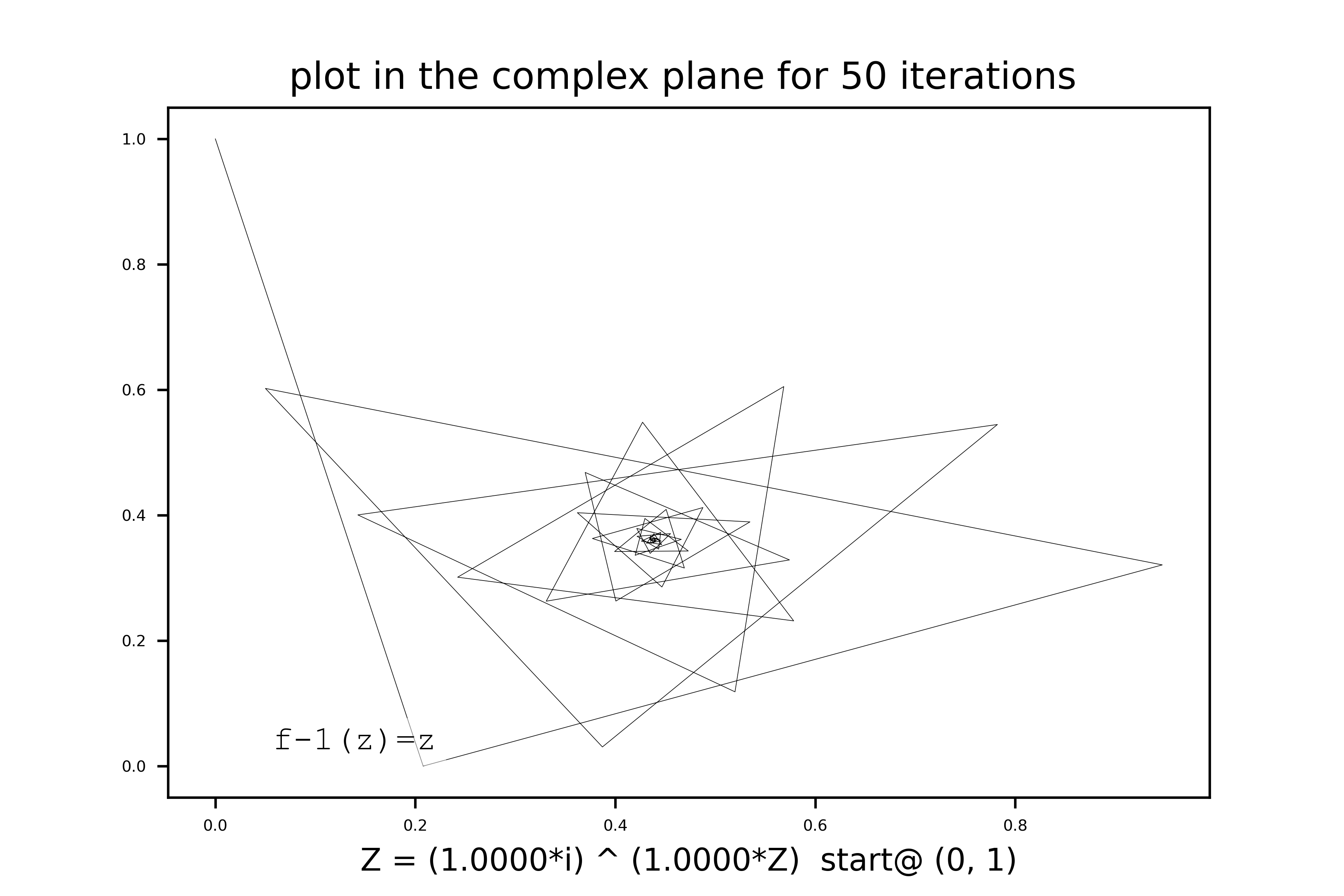
For those unfamiliar with the Lambert W function, there's a much more direct route in: pick a complex starting value, plug it into iz, and feed the result back in as the new z. That's the entire iteration. The figure below shows what that looks like in practice — a spiral tightening down onto the solution 0.43828 + 0.36059i.
z = iz, starting at (0, 1), 50 steps — converging to the fixed point.
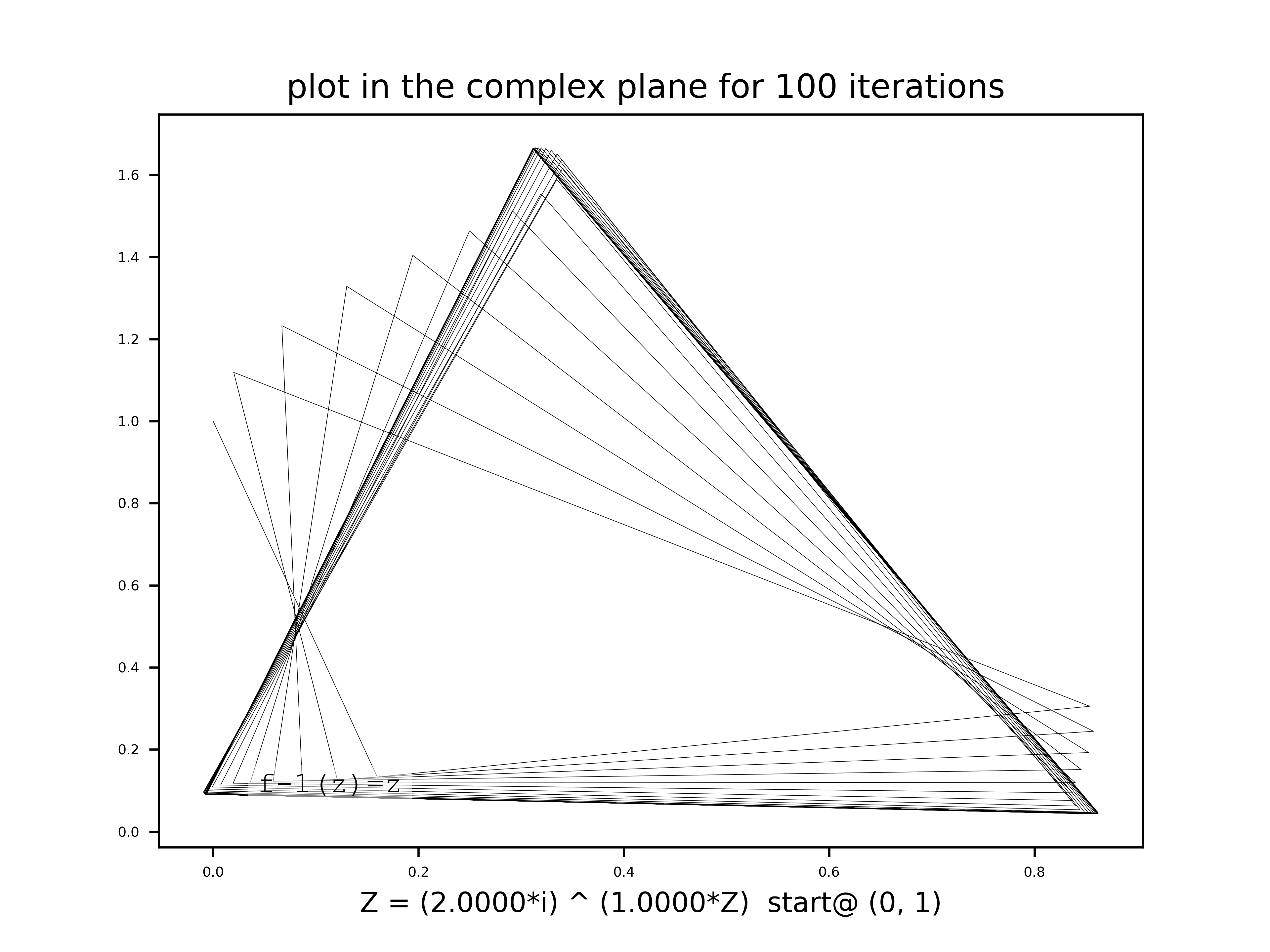
A small experimental change to the original equation started the real adventure. Taking z = (2·i)z instead — base multiplied by 2 rather than left alone — gives a very different picture: the trajectory no longer spirals into a single point, but circles around a small loop of values. The first clue that cyclic solutions exist at all.
z = (2·i)z, starting at (0, 1), 100 steps — the first sign of a cyclic attractor.
That single accident made it worth generalizing the problem properly — replacing the fixed base 2 with a free parameter a, and the exponent's coefficient with a second parameter b. From there it was a long stretch of trial and error, long before the idea of a parameter space portrait existed. For many values of (a, b), the iteration either refused to converge at all, or converged so slowly that it ran out of patience before settling down. Those points were never given any special status at the time — they were simply the ones that hadn't found an attractor yet. But the path the iteration traced through the complex plane on the way there was, again and again, strikingly beautiful in its own right. A selection of these trajectories follows below.
Gallery · Trial & Error
Trajectories through the complex plane.
Each image below traces the path of a single point z through the complex plane as the iteration runs — not a parameter space portrait, but the raw trajectory itself, for one particular (a, b) at a time. These come from the period before the parameter space idea existed, when the only way to see anything was to plot one trajectory and look.
Some of these plots skip points rather than connecting every single iteration — visible in the filename as "mod 2", "mod 4", and so on. Plotting every consecutive point can bury the underlying shape in dense overlapping lines; connecting only every 2nd or 4th point instead thins the trajectory out and lets the actual geometry show through. It's purely a presentation choice made after the fact — the underlying iteration is identical either way.
Loading gallery…
It was this growing pile of individually beautiful, individually unexplained pictures that eventually demanded a better overview — a way to see, at a glance, what kind of behavior to expect from any given (a, b) before running the iteration at all. That demand is what led to the parameter space portrait described next.
02 — The Equation
Four characters. An inexhaustible universe.
The generalization introduced here replaces the base i with a·i and couples the exponent to a second parameter b:
z = (a·i)(b·z)
Here a and b are real parameters, and z is complex. For each choice of (a, b), the iteration zn+1 = (a·i)(b·zn) either converges to an attractor — a fixed point, a 2-cycle, a 3-cycle — or it diverges. The question becomes: what does the space of all possible behaviors look like?
"The (a, b) plane is not the complex plane. It is a real parameter space — a map of qualitative behaviors, not values. A different kind of fractal portrait entirely."
03 — The Parameter Space
Every pixel is a question. Every color is an answer.
For each point (a, b) in the parameter plane, the iteration is run up to 500 times from a fixed starting value. The result — which attractor the system finds, or whether it escapes — determines the color of that pixel.
Divergence
Fixed point (1-cycle)
2-cycle
3-cycle
4-cycle
5-cycle
6-cycle
7-cycle
8-cycle
9-cycle
10-cycle
>10-cycle
The result is a parameter space portrait — in spirit related to the Mandelbrot set, but for a transcendental family rather than a polynomial one. Large smooth basins of stable behavior are separated by fractal boundaries of infinite complexity. Stable cycles of order up to at least 40 have been identified across the parameter plane.
Crucially, this is not a portrait of the complex plane. The axes are real parameters a and b. The fractal structure emerges from the sensitivity of the dynamics to these parameters — a shadow of complex behavior cast onto a real plane.
Two further quantities govern how each pixel's outcome is decided, and both leave a visible signature on the final image:
Iteration count: 500
How many times the equation is applied before giving up on finding a stable cycle. Too few iterations and slow-converging regions are misread as divergent; too many costs computation time for little extra detail. 500 has settled in as the standard value.
Tolerance: 10−15
The maximum allowed difference between consecutive values of z before a cycle is considered "found." A looser tolerance finds cycles faster but blurs fine boundary detail; a tighter one sharpens the fractal edges at the cost of more iterations needed to confirm stability. 10−15 has become the standard.
Both parameters trade computation time against image fidelity. Near the fractal boundaries — where convergence is slowest and most sensitive — small changes to either value can shift the exact location of a boundary by a visible amount, though the overall character of the portrait remains stable. 500 iterations and a tolerance of 10−15 are now the standard for everything on this site; a few of the earliest images, made while these values were still being settled on, may differ very slightly.
Zooming into boundary regions reveals an endlessly varied world: cascading teardrops, floral rosettes, fractal foam, tendril networks. No exact self-similarity has been found — the same motifs recur at different scales, but are never identical. This is consistent with the transcendental nature of the family, which lacks the renormalization symmetry of polynomial systems.
Gallery
Images from the parameter space.
A selection of views across the (a, b) plane — from the full overview to deep zooms into boundary regions. Low-resolution thumbnails load instantly; click any image to open the full-resolution version.
Loading gallery…
The images here are capped at 2500×2500 to keep the page light. A handful of select views exist at 5000×5000 and one at 10,000×10,000 — far too large to host directly here.
For those willing to spend the download time → original resolution archive ↗ If that link comes up empty, the share has likely expired on my end — drop me a line at contact@bob2026.fr and I'll refresh it.
scroll · zoom | drag · pan | dbl-click · reset | ESC · close
↓ Download
Loading high-res…
04 — The Third Parameter
Replacing i with iC: a hidden periodicity.
Introducing a third parameter C — replacing i with iC in the base — rotates the complex argument of the base by Cπ/2. Since a full rotation returns to the start, the system is periodic with period 4 in C.
C = 1Base case i1 = i
C = 2i2 = −1, real axis
C = 3Mirror of C = 1
C = 4Mirror of C = 2
Sweeping C between 0 and 4 across multiple frames produces an animation in which fractal clouds drift and morph over stable colored basins — a one-parameter movie through a four-dimensional mathematical object.
Gallery · Type 2
Images from the C parameter family.
Parameter space portraits for the generalized family z = ((a·iC))(b·z) at selected values of C. The global structure persists across the period-4 cycle while the internal geometry transforms continuously.
Loading gallery…
Gallery · Type 3 and Higher
Further explorations.
While investigating variations of the generalized equation, a number of visually striking parameter space portraits emerged from families not covered by the Type 1 and Type 2 galleries above. These are included here purely for their visual merit and as background examples — each represents a different structural family with its own attractor geometry. Whether these connect to known mathematical objects remains an open question, and one worth exploring. Consider this an invitation to do your own research.
Loading gallery…
05 — Stereoscopic Depth
The color scheme is also a perfect depth map.
Each color in the parameter portrait encodes a discrete, unambiguous depth level: fixed points (red) at level 1, 2-cycles (green) at level 2, and so on. This turns out to be an ideal stereogram depth map — large flat basins give clean depth planes, sharp color boundaries give crisp 3D edges, and 10+ distinct levels produce genuine layering.
Viewing the original image alongside a version with a carefully chosen pixel horizontal shift applied per depth level — using wall-eyed free-viewing — produces a striking three-dimensional effect. The basin interiors float at different depths; the fractal boundaries appear as complex terrain between them.
"The mathematics accidentally designed a perfect depth map before anyone knew one was needed."
Viewing tip: start with the image small and close to your screen. Let your eyes relax until the two panels merge into one. Once depth appears, slowly move back or enlarge the image for a more immersive experience.
06 — Interactive 3D Relief
Each color layer becomes a floating slab in space.
The depth encoding extends naturally into three dimensions. Each color region is extruded into a flat slab at a depth proportional to its cycle order, producing a layered relief sculpture of the parameter space — the black divergence region as a backplane, with colored basins floating in front of it at increasing distances.
The resulting object can be orbited, zoomed, and panned freely. Viewed from an angle, the fractal boundary regions reveal themselves as complex terrain — the same boundaries that appear as thin lines in the 2D portrait become dramatic cliffs and shelves in three dimensions.